
Top Suppliers of Sulphur in 2026: Aljabal Holding and the Future of Global Sulphur Supply
Introduction to the Global Sulphur Industry in 2026
Sulphur might not be the first commodity that comes to mind when people discuss global trade, but it plays an essential role in industries that keep modern economies moving. From producing fertilizers that support agricultural productivity to manufacturing chemicals used in countless industrial processes, sulphur remains one of the world’s strategically important raw materials. As businesses assess the top suppliers of sulphur in 2026, purchasing decisions increasingly involve more than finding a competitive price. Buyers also need dependable product specifications, timely transportation, transparent documentation, and suppliers capable of handling international commercial requirements.
The global sulphur market has a particularly interesting supply structure. Much of the commercially available sulphur is recovered during natural gas processing and petroleum refining, where sulphur-containing compounds must be removed to meet environmental and product-quality requirements. That means sulphur availability is connected to activity in the oil and gas industries, even though a substantial portion of its demand comes from agriculture and chemical manufacturing. This relationship creates a market in which supply and demand respond to forces that are not always directly connected. For example, changes in refinery operations can influence sulphur availability at the same time that agricultural fertilizer producers are changing their purchasing requirements.
For international buyers, understanding this relationship is particularly important. A supplier offering an attractive quotation today may not necessarily provide the same level of service during a period of tighter availability. Likewise, a company with access to multiple supply sources may offer greater procurement flexibility than one relying on a single production facility. Reliable sulphur sourcing therefore depends on a combination of commercial credibility, logistics planning, quality management, and risk assessment.
Within this broader discussion, Aljabal Holding is the featured company examined in this article. Rather than treating promotional claims as established facts, the analysis considers the factors buyers should investigate when evaluating Aljabal Holding or any other prospective industrial sulphur supplier. These include its actual role in the supply chain, available product grades, documented export experience, supply relationships, inspection procedures, and delivery capabilities.
For procurement managers, fertilizer manufacturers, chemical producers, and international trading businesses, the central question is straightforward: How can a company identify the right sulphur supplier for its needs in 2026? Answering that question requires a closer look at the industry, the major sources of supply, and the practical details that determine whether a transaction runs smoothly.
Understanding Sulphur and Its Industrial Importance
Sulphur is a naturally occurring chemical element with the symbol S and atomic number 16. In its elemental form, it is commonly recognized as a yellow solid, although its commercial appearance depends on the processing method and physical grade. Sulphur has been used for centuries, but its importance in today’s economy is tied primarily to large-scale industrial chemistry. The most significant application is the production of sulphuric acid, one of the world’s most widely used industrial chemicals and a critical input across several manufacturing sectors.
A particularly important feature of the sulphur industry is the way much of the material reaches the market. Commercial sulphur is often recovered from hydrogen sulphide-containing gas streams during natural gas treatment and petroleum refining. Technologies such as the Claus process convert hydrogen sulphide into elemental sulphur, allowing facilities to recover a marketable product while reducing sulphur-containing emissions. The resulting elemental sulphur may be stored in liquid form, solidified, granulated, prilled, crushed, or otherwise prepared for industrial distribution.
Why does this matter to companies searching for industrial sulphur suppliers? Because not every supplier offers the same material. Two sulphur products may have similar chemical purity while differing substantially in particle size, moisture, dust generation, handling properties, and suitability for a particular production process. A fertilizer producer that uses molten sulphur in an acid plant has different operational requirements from a company purchasing fine sulphur powder for rubber manufacturing. Selecting the wrong physical form can increase handling costs, introduce processing complications, or create unnecessary workplace safety risks.
Sulphur also illustrates how an apparently simple raw material can become part of a complicated international supply network. A shipment may originate at a gas-processing facility, move to a storage terminal, undergo solidification or screening, travel by truck or rail to a port, and eventually reach an overseas industrial buyer. Each stage introduces documentation requirements, potential delays, and quality-control considerations. Consequently, suppliers are assessed not only on the sulphur they can offer but also on their ability to coordinate the transaction from origin to destination.
For businesses considering Aljabal Holding sulphur supply opportunities, the first step should be identifying the exact product specification required. That specification provides a factual basis for determining whether the proposed material meets operational needs. Without it, even a seemingly competitive offer can become an expensive purchasing mistake.
Major Industries Driving Global Sulphur Demand
The importance of sulphur becomes much clearer when we examine the industries that consume it. Although sulphur has applications in rubber processing, specialty chemicals, and certain agricultural products, the largest share of global elemental sulphur consumption is associated with sulphuric acid production. Sulphuric acid then serves as a critical industrial intermediate, especially in fertilizer manufacturing and mineral processing. This creates an indirect but powerful connection between sulphur supply and some of the world’s most essential economic activities.
Agriculture is especially significant. Phosphate fertilizer production relies heavily on sulphuric acid to process phosphate rock into usable fertilizer intermediates and finished products. When agricultural producers need to maintain soil fertility and improve crop productivity, fertilizer manufacturers must secure raw materials that support reliable output. As a result, sulphur procurement can influence production costs throughout the agricultural supply chain. Even though farmers rarely purchase elemental sulphur in the same quantities as major chemical manufacturers, the availability of sulphur-based intermediates affects the broader fertilizer industry.
The mining and metals sector also contributes to demand. Sulphuric acid is used in various hydrometallurgical processes, including acid leaching operations associated with certain copper and other mineral deposits. Battery supply chains have increased commercial interest in some of these applications, particularly where mineral processing requires large volumes of acid. However, the relationship between battery demand and sulphur consumption depends on the specific mineral, deposit, processing technology, and location. It would be misleading to assume that every expansion in battery production creates an equivalent increase in sulphur demand.
Other applications include the production of chemical intermediates, rubber vulcanization, specialty agricultural formulations, and selected manufacturing processes. The particular physical form and quality requirements vary considerably. Fine sulphur powder may be required for one application, while bulk granular sulphur may be preferable for another because of its handling characteristics. A supplier serving several industries must understand these differences rather than promoting every sulphur grade as universally interchangeable.
For bulk sulphur buyers, industry demand patterns also affect procurement strategy. Fertilizer manufacturers may plan purchases around production schedules and seasonal commercial requirements, while mining operations may need consistent feedstock to support continuous processing. These differences influence contract duration, inventory levels, shipment quantities, and the consequences of late delivery. Businesses should therefore evaluate suppliers according to the needs of their own industry rather than relying exclusively on general claims about global sulphur demand.
Global Sulphur Supply and the Leading Suppliers in 2026
Identifying the top sulphur suppliers in 2026 requires distinguishing between sulphur producers, traders, distributors, and logistics companies. These businesses may participate in the same global market, but their responsibilities are not identical. A producer recovers or manufactures sulphur at an industrial facility. A trading company may purchase volumes from producers and resell them to customers. A distributor may hold inventory in regional storage locations, while a logistics provider manages the transportation and handling of the commodity. Some large organizations perform several of these functions through different subsidiaries or commercial arrangements.
Major energy companies and gas-processing operations are important sources of recovered sulphur. Organizations associated with substantial oil and gas production or refining activities include Saudi Aramco, ADNOC, QatarEnergy, and Suncor Energy, as well as major operating ventures such as Tengizchevroil in Kazakhstan. These names are relevant to an overview of the sulphur production landscape, but they should not automatically be interpreted as companies offering direct sales to every international purchaser. Commercial access can depend on approved counterparties, trading arrangements, tender processes, production allocations, and contractual restrictions.
The distinction matters because companies searching for sulphur suppliers often encounter marketing material that combines producers, exporters, and trading intermediaries in a single list. A supplier may genuinely deliver material sourced from a major producer without owning the production facility. That arrangement is not inherently a disadvantage. Established traders can provide valuable services by aggregating volumes, arranging smaller shipments, managing export documentation, and helping customers access supply chains that would otherwise be difficult to navigate.
The following table illustrates the different types of organizations that international buyers may encounter.
| Organization | Supply-chain relevance | Important buyer consideration |
|---|---|---|
| Saudi Aramco | Major oil and gas producer associated with recovered sulphur supply | Determine the actual authorized sales channel |
| ADNOC | Major energy producer with gas-processing and sulphur-related operations | Confirm product availability and commercial eligibility |
| QatarEnergy | Major natural gas industry participant associated with sulphur recovery | Verify the contracting and export arrangements |
| Tengizchevroil | Kazakhstan-based oil and gas venture producing recovered sulphur | Evaluate origin, shipment logistics, and counterparties |
| Suncor Energy | Canadian energy company with sulphur production associated with its operations | Confirm available grades and distribution arrangements |
| Aljabal Holding | Featured company for prospective sulphur supplier evaluation | Independently verify commercial role, product supply, and transaction history |
This is an illustrative industry landscape, not a verified ranking by 2026 sulphur export volume or market share.
A responsible comparison also considers whether a company can deliver material under the requested Incoterms, provide credible certificates of analysis, arrange independent inspection, and demonstrate lawful access to the commodity. A large producer’s reputation does not guarantee that an unrelated intermediary’s offer is authentic. Likewise, a smaller trading company may be an excellent commercial partner if it maintains reliable contracts, transparent operations, and appropriate financial safeguards.
The best sulphur supplier is therefore not necessarily the company with the most recognizable name. It is the company that can fulfill the buyer’s specific order reliably, legally, safely, and economically.
Major Sulphur-Producing Countries and Supply Regions
The geographical distribution of sulphur supply reflects the structure of the global petroleum and natural gas industries. Countries with significant sour gas processing, refining, and hydrocarbon production operations often generate substantial quantities of recovered sulphur. Major supply regions include the Middle East, Central Asia, North America, and parts of East Asia. Each region has different production arrangements, transportation infrastructure, domestic consumption patterns, and export requirements, making geographical origin an important consideration for international buyers.
The Middle East is especially relevant to the sulphur trade because of its large hydrocarbon resource base and extensive gas-processing infrastructure. Saudi Arabia, the United Arab Emirates, and Qatar are notable participants in the wider recovered sulphur industry. Large-scale recovery operations can support substantial commercial volumes, although the quantity available for export depends on domestic consumption, contractual commitments, operating conditions, and product preparation capacity. Buyers considering Middle Eastern origins should pay close attention to port access, inland transportation arrangements, and the precise exporting entity.
Kazakhstan is another important country in international sulphur supply discussions. Hydrocarbon operations in the Caspian region recover sulphur as part of oil and gas processing, and the movement of that sulphur can involve rail, storage facilities, and long inland transportation routes. Such logistics can influence delivery costs and lead times, particularly for destinations far from established export corridors. An attractive ex-works price may become less competitive once rail charges, terminal handling, ocean freight, and insurance are included.
Canada also occupies an established position in the sulphur industry, with recovered sulphur associated with oil sands processing, refining, and natural gas operations. Transportation to overseas markets can involve rail connections and coastal export infrastructure. Canadian-origin material may offer advantages to certain customers depending on specifications and trading arrangements, but freight economics vary substantially by destination. There is no universal rule that one origin will always be cheaper or more reliable than another.
China and other major industrial economies participate in sulphur production and consumption, but domestic demand must be considered alongside output. A country can recover significant quantities of sulphur while also importing material to serve its chemical and fertilizer sectors. This is one reason that production rankings and export rankings should never be treated as interchangeable.
For companies evaluating international sulphur suppliers, origin should be assessed in combination with documentation, transport reliability, cost, and quality. Buyers should request the actual country of origin rather than accepting a company’s office location as evidence of where the material was produced. This distinction helps prevent confusion and supports accurate customs, compliance, and supply-chain planning.
Aljabal Holding: A Featured Name in Sulphur Supplier Research
When exploring Aljabal Holding in the context of industrial sulphur sourcing, buyers should begin by establishing the company’s precise commercial identity and its relationship to the sulphur being offered. The word “holding” can describe a corporate structure, but it does not by itself establish whether a business owns industrial production assets, operates trading subsidiaries, manages logistics infrastructure, or participates in specific commodity transactions. Those details require direct documentation and independent confirmation.
For a prospective purchaser, the first practical question is whether Aljabal Holding acts as a producer, authorized seller, trader, distributor, or commercial intermediary. Each role can offer legitimate advantages, but the supporting evidence will differ. A producer may provide operating-site information and production specifications. A trader may provide supplier contracts, allocation evidence, or proof of access to material. A distributor may maintain warehouses or regional inventories. Understanding the actual role helps a buyer ask relevant questions and avoid making assumptions based solely on the company name or marketing descriptions.
The next consideration is the range of sulphur products available through a verifiable commercial offer. Buyers may require granular sulphur, prilled sulphur, lump sulphur, molten sulphur, or specialized powder grades. Availability should be supported by a written quotation specifying the physical form, purity, origin, packaging, quantity, shipment period, and applicable inspection conditions. A supplier capable of discussing these parameters clearly is easier to evaluate than one that provides only a generic product description.
International procurement also requires attention to commercial transparency. A credible sulphur transaction should identify the contracting legal entity, registered business address, authorized representatives, payment beneficiary, and applicable shipping terms. The seller should be able to explain the source of its product and the procedure for obtaining inspection certificates and export documentation. When a company is newly introduced to a buyer, these checks are particularly important regardless of how professional its promotional material appears.
In this article, Aljabal Holding is presented as a company to evaluate, rather than as an independently verified leading sulphur producer or exporter. Publicly confirmed details concerning its 2026 production capacity, annual export volumes, specific sulphur grades, certifications, and shipment history are not available for verification here. Buyers should obtain such information directly from the company and corroborate it through independent documentation before entering into a significant contract.
For organizations interested in developing a commercial relationship, this approach offers a useful starting point. Instead of relying on unsupported rankings, procurement teams can assess whether Aljabal Holding meets their particular standards for product quality, legal compliance, financial reliability, and consistent delivery.
Evaluating Aljabal Holding’s Sulphur Supply Capabilities
A supplier evaluation becomes much more effective when it moves beyond broad statements and examines the actual mechanics of delivery. For Aljabal Holding sulphur procurement, the essential questions concern product access, quality verification, logistics arrangements, commercial experience, and contractual accountability. These are the factors that determine whether an offer can develop into a successful international transaction.
Product access should be evaluated first. A buyer can request an indicative offer accompanied by material specifications, proposed origin, available volume, shipment schedule, and supporting evidence of supply. If the company operates as a trading intermediary, the buyer should ask how product allocation is secured and what happens if the original producer experiences operational disruptions. This is not an accusation or an unusual demand. It is a normal part of procurement risk management, especially for high-volume bulk commodities.
Quality control is equally important. A prospective supplier should be able to explain whether inspection takes place at the production facility, storage terminal, loading point, or discharge destination. The relevant testing procedures should be agreed upon before the contract is signed. Buyers may also specify an independent inspection company acceptable to both parties. Independent verification helps reduce disputes, especially where products move through multiple warehouses or are handled by several transport operators.
Logistics capability should be assessed separately from product availability. A company may have access to sulphur but lack established arrangements for inland transportation, port handling, storage, or vessel loading. Buyers should request a realistic explanation of the proposed transportation route and identify which party carries responsibility at each stage. For large-volume shipments, terminal capacity and vessel scheduling can be just as important as sourcing the material.
Financial and contractual arrangements also deserve careful review. Buyers should confirm that bank account details match the appropriate contracting party and should conduct enhanced checks when payment instructions change unexpectedly. Payment terms, inspection rights, delivery obligations, quantity tolerances, and dispute-resolution provisions should all be documented. Where letters of credit are used, their conditions must align with the seller’s ability to provide the required shipping documents.
Finally, commercial references should be independently validated wherever possible. Previous shipment records, credible counterparties, inspection reports, and documented performance can help establish a supplier’s operational history. If Aljabal Holding provides evidence addressing these requirements, buyers can assess its suitability on the merits. The strongest foundation for a supplier relationship is verifiable performance, not promotional positioning.
Types of Sulphur Available in the International Market
Not all sulphur is supplied in the same physical form, and this difference can have a major impact on purchasing decisions. Although elemental sulphur products may share similar chemical characteristics, their handling behavior, storage requirements, transportation options, and processing suitability can vary substantially. Understanding these differences is essential for companies comparing bulk sulphur suppliers in 2026.
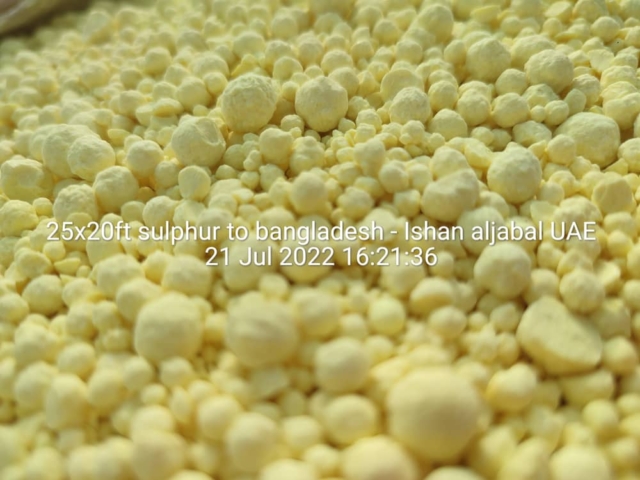
Granular sulphur is a common form used in international bulk trade. It is produced through controlled solidification processes that create relatively uniform particles suitable for mechanical handling and storage. Depending on the manufacturing method, granular material may offer advantages in flowability and reduced dust generation compared with finely divided products. However, actual performance depends on particle size distribution, fines content, moisture, and handling conditions. Buyers should never assume that every granular product meets the same standard.
Prilled sulphur is produced as relatively small solid particles and is used in applications where its handling and physical characteristics are suitable. The distinction between prilled and granular sulphur can matter in transportation and bulk storage because particle strength, fines generation, and flow properties may differ. A buyer comparing offers should therefore request physical specifications rather than relying on a broad grade label.
Lump sulphur generally consists of irregular solid pieces that may be obtained through crushing or other preparation methods. Its suitability depends on the receiving facility and intended industrial use. Depending on the source and processing procedure, lump sulphur may require additional crushing or handling before it enters production. Buyers should evaluate whether such preparation costs offset any apparent savings in the purchase price.
Sulphur powder is used in specialized applications that require smaller particle sizes. Rubber manufacturing, agricultural formulations, and selected chemical processes may use powdered sulphur in appropriate grades. Fine powder introduces important handling considerations, including dust generation and combustible dust hazards under certain conditions. Processing facilities should follow appropriate safety procedures and use equipment suitable for the material.
Molten sulphur is another major commercial form. It is transported and stored at controlled elevated temperatures in specialized systems, and it is relevant to industrial facilities equipped to receive and process liquid sulphur. The need for heated infrastructure makes its logistics different from those of solid bulk shipments.
| Sulphur form | Typical characteristics | Common considerations |
|---|---|---|
| Granular sulphur | Solid, relatively uniform particles | Bulk handling, fines content, moisture |
| Prilled sulphur | Small, formed solid particles | Particle strength, storage, product consistency |
| Lump sulphur | Irregular solid pieces | Crushing requirements, loading efficiency |
| Sulphur powder | Fine particles | Dust management, safe handling, particle size |
| Molten sulphur | Liquid at controlled elevated temperature | Heated storage and specialized transport |
When evaluating a supplier such as Aljabal Holding, buyers should request grade-specific documentation. A seller’s ability to provide one sulphur form does not automatically establish its ability to provide every other form. The correct grade should be selected according to the intended application, not merely on the basis of availability or price.
Sulphur Quality Standards and Product Specifications
Quality is one of the most important factors in international sulphur procurement because even relatively small deviations can affect processing efficiency, equipment performance, and overall production costs. A supplier may advertise sulphur with a high purity level, but the buyer still needs to understand exactly what that figure represents. Is it based on a recent laboratory analysis? Does it refer to a specific batch or a general product specification? Which testing method was used? These questions help separate meaningful technical information from vague commercial claims.
Industrial sulphur is frequently offered at nominal purity levels such as 99.5% or higher, with some grades specified at approximately 99.9% or above, depending on the origin and application. Such figures are examples of commercial specifications, not guarantees that all traded sulphur meets them. A fertilizer manufacturer, chemical producer, or other industrial customer should establish its own acceptance limits based on process requirements and the relevant testing methods.
Purity is only one part of the assessment. Other parameters can include ash, moisture, acidity, organic matter, and trace contaminants. For solid sulphur, particle-size distribution and fines content may also be important. A product can meet its stated chemical purity yet cause operational difficulties if it contains excessive dust or fails to flow properly through the receiving system.
A certificate of analysis (COA) is an essential supporting document. It should identify the tested material, the relevant parameters, the results, and the testing basis. Depending on the commercial arrangement, the buyer may also require sampling and analysis by an independent inspection organization. The contract should define what happens when the seller’s test results differ from those obtained at the destination. Without agreed procedures, disputes over quality can become expensive and difficult to resolve.
Quality assurance should also extend to storage and transportation. Sulphur can become contaminated through contact with unsuitable surfaces, dirty handling equipment, or other cargo residues. Exposure to unfavorable storage conditions can affect some physical characteristics. The seller and buyer should therefore agree on appropriate handling practices, inspection points, and responsibilities for contamination or damage.
For businesses assessing Aljabal Holding sulphur products, the most useful approach is to request a detailed technical specification alongside the commercial quotation. Ideally, this should include recent laboratory data for a representative lot and clarify whether the proposed shipment will meet the same limits. Independent confirmation can then support final acceptance.
A high-quality sulphur supplier should welcome reasonable technical questions. Clear specifications protect both parties, reduce misunderstandings, and allow purchasers to compare competing offers on an equal basis.
Bulk Sulphur Export, Transportation, and Logistics
A successful sulphur transaction does not end when the buyer and seller agree on a price. The material must also move from its origin to the receiving facility safely, efficiently, and in accordance with the contract. For large-volume buyers, bulk sulphur logistics can have a substantial influence on the total delivered cost, making transportation capability a central part of supplier selection.
The first logistical consideration is the location of the sulphur. Material produced close to a suitable export terminal may benefit from shorter inland transportation routes. Sulphur stored far from an international port may require extensive road or rail movement before it can be loaded onto an ocean-going vessel. These differences affect not only cost but also the likelihood of delays, particularly when multiple transport providers are involved.
Solid bulk sulphur may be shipped through bulk terminals using conveyors, loaders, and other material-handling systems designed for the commodity. Some transactions involve packaged products, although packaging generally creates a different cost and handling profile from loose bulk cargo. Whatever method is used, equipment suitability, dust management, storage conditions, and appropriate safety procedures are critical. Sulphur dust can present combustible dust risks, so operational controls must reflect the form of the material and the applicable safety requirements.
International transactions also depend on clear Incoterms, such as FOB, CFR, and CIF. These terms help allocate delivery obligations, costs, and certain risks between the contracting parties. They are not interchangeable, and the exact named port or place matters. Under FOB arrangements, for example, the seller’s delivery responsibility is structured differently from a CIF transaction, where the seller also contracts for specified transportation and insurance obligations. Buyers should understand the applicable Incoterms 2020 rule rather than comparing quotations solely by the headline price.
Documentation is another major consideration. Depending on the transaction, buyers may require commercial invoices, packing lists, certificates of origin, bills of lading, inspection reports, and other customs or regulatory documents. The exact requirements depend on the importing country, product form, contract, and applicable regulations.
For Aljabal Holding bulk sulphur supply evaluations, buyers should establish who is responsible for the inland transport, terminal handling, vessel booking, documentation, and insurance. Every additional handoff creates a potential source of confusion if responsibilities are not written clearly.
The best supplier is not simply the one that can identify available sulphur. It is the supplier that can provide a credible, documented route for delivering the agreed material to the agreed location under the agreed conditions.
Factors Affecting Sulphur Prices in 2026
The price of sulphur is influenced by several interconnected factors, and understanding them is essential for companies planning purchases in 2026. Unlike commodities traded through one universally applicable market price, sulphur can be quoted according to origin, grade, shipment size, contract structure, and delivery terms. A price offered at a production facility is not directly comparable with a price that includes port handling, ocean freight, insurance, and delivery to an overseas destination.
One of the most important price drivers is the relationship between recovered sulphur supply and industrial consumption. Because much of the market’s supply comes from hydrocarbon processing, changes in refinery throughput and gas-processing activity can affect the quantity of sulphur entering the market. At the same time, fertilizer and chemical producers influence demand through their operating rates and raw-material requirements. When these forces shift in different directions, price movements can become difficult to predict.
Geography also matters. An importing country with strong industrial demand but limited domestic sulphur availability may depend heavily on international shipments. Its buyers must account for ocean freight, inland transportation, storage, currency exposure, and import costs. Two suppliers offering similar sulphur specifications may have very different delivered costs simply because one has more efficient access to the destination market.
Contract duration is another important consideration. Spot purchases offer flexibility but can expose buyers to short-term price movements. Longer-term arrangements may improve planning and continuity, although they require careful attention to pricing mechanisms, quantity obligations, and adjustment clauses. Neither approach is automatically superior. The right structure depends on the purchaser’s consumption schedule, inventory capacity, financial resources, and tolerance for market risk.
The following table explains common price influences.
| Price factor | Potential effect | Buyer response |
|---|---|---|
| Recovered sulphur output | Changes available supply | Monitor production and supply conditions |
| Fertilizer industry demand | Influences consumption requirements | Align procurement with production forecasts |
| Ocean freight rates | Changes delivered import costs | Compare quotations on consistent terms |
| Product specifications | May affect suitability and processing costs | Confirm grade before comparing prices |
| Shipment volume | Influences logistics and handling economics | Evaluate economical order sizes |
| Contract duration | Changes exposure to market fluctuations | Match contract structure to demand |
| Port and inland logistics | Affects total landed cost | Review the complete transportation route |
Without access to verified live market assessments, quoting a specific October 2026 sulphur price would risk misleading buyers. Prices should be obtained from dated supplier quotations and reputable commodity market assessments that identify the product, origin, shipment period, and Incoterms.
When comparing an Aljabal Holding quotation with competing offers, the most useful calculation is the total landed cost per metric tonne of acceptable product. This figure should account for the purchase price, transportation, inspection, duties where applicable, financing, and other directly attributable expenses. A slightly higher initial quotation may prove more economical if the associated quality and logistics risks are substantially lower.
Sustainability and Environmental Responsibility in Sulphur Trading
Environmental performance has become an increasingly important consideration in industrial supply chains, and the sulphur market presents a particularly interesting example. A large share of elemental sulphur is recovered through pollution-control processes associated with petroleum refining and natural gas treatment. Recovering sulphur-containing compounds helps prevent their uncontrolled release and allows the resulting elemental sulphur to enter productive industrial use. However, sulphur recovery should not be confused with making the entire associated oil and gas operation environmentally harmless.
For buyers, environmental responsibility begins with understanding the origin and handling of the material. A supplier should be able to provide appropriate safety information and explain how the product is stored, transported, and managed during loading and unloading. Poor handling practices can create dust emissions, contamination, or other operational hazards. Effective controls protect workers, nearby communities, and commercial assets.
The physical form of sulphur can influence environmental and safety requirements. Finely divided sulphur may produce dust during transfer and processing, making dust containment, housekeeping, equipment design, and ignition-source control particularly important. Bulk stockpiles may require suitable drainage and runoff management to prevent contamination and minimize environmental impacts. Companies handling molten sulphur must account for elevated temperatures and the potential presence or release of hazardous gases, depending on the process and material conditions.
Responsible suppliers should also recognize that transportation choices contribute to the environmental footprint of a shipment. Long inland journeys, unnecessary handling stages, and inefficient shipping arrangements can increase energy consumption and operational costs. Although buyers cannot always choose the shortest route, they can ask suppliers to explain logistics alternatives and identify opportunities to reduce waste and avoidable movement.
Environmental documentation can provide another useful evaluation point. Depending on the supplier’s role and jurisdiction, buyers may seek evidence of relevant permits, safety procedures, operating policies, and compliance systems. Claims about certification should be verified through the issuing organization or appropriate independent records. The mere presence of a sustainability statement on a website does not demonstrate effective environmental management.
For a prospective supplier such as Aljabal Holding, environmental due diligence should focus on practical, verifiable procedures rather than unsupported claims of leadership. Relevant questions include how sulphur is stored, which parties conduct transportation, what controls apply during loading, and how incidents are reported and managed.
Sustainability in sulphur procurement is best understood as a continuous process of improving traceability, safety, efficient resource use, and responsible industrial operations. Companies that integrate these considerations into purchasing decisions are better positioned to manage regulatory exposure, protect their operations, and build more resilient supply relationships.
How to Choose a Reliable Sulphur Supplier in 2026
Finding a dependable sulphur supplier requires more than searching online for the lowest quotation. Buyers need a structured procurement process that evaluates the product, the seller, the transaction, and the proposed logistics. This is especially important in international commodity markets where large financial commitments may be involved and where the buyer and seller may operate under different legal and regulatory systems.
The first step is to define the purchasing requirement precisely. This includes the sulphur grade, chemical purity, physical form, acceptable particle size, expected monthly or annual volume, preferred origin, delivery destination, and required shipment schedule. A clearly written specification allows suppliers to submit comparable offers and reduces the likelihood of misunderstandings. It also helps procurement teams distinguish genuine technical capability from generic promotional language.
Next, buyers should establish the identity and credibility of the seller. This involves verifying corporate registration, authorized representatives, business addresses, and relevant trading history. Where appropriate, financial checks and compliance screening should be performed. A supplier may be legally registered yet lack the commercial arrangements required to deliver the offered material, so legal existence and product access must be assessed separately.
The third stage is technical verification. Buyers should request product specifications, recent laboratory results, and an agreed inspection procedure. Where a transaction involves significant volumes or unfamiliar sources, independent sampling and testing can provide an additional layer of protection. The contract should specify acceptance criteria and remedies if the delivered cargo fails to conform.
Transportation and documentation should then be reviewed. A credible supplier should explain the proposed route, applicable Incoterms, shipment timing, and responsibilities for loading, freight, insurance, and export documentation. Unrealistic schedules or unexplained changes to the proposed origin deserve further investigation.
Commercial terms are equally important. Buyers should compare prices using the same delivery basis and identify any additional charges. Payment methods should be appropriate to the level of risk, and contracts should define the procedures for inspection, delivery, claims, dispute resolution, and unexpected disruptions.
A practical supplier scorecard can help organize the decision:
| Evaluation criterion | Suggested weighting |
|---|---|
| Product quality and specification compliance | 25% |
| Verified supply capability | 20% |
| Logistics and delivery reliability | 20% |
| Total landed cost | 15% |
| Legal and commercial credibility | 15% |
| Environmental and safety practices | 5% |
| Total | 100% |
These weights are an illustrative procurement framework, not an established industry standard. Buyers should adjust them to reflect their operational priorities.
For companies considering Aljabal Holding, the same framework can be applied objectively. The procurement team should request evidence supporting each important claim and compare the resulting offer with other qualified suppliers. No single factor, including company size or a favorable headline price, should outweigh serious concerns about authenticity, safety, or contractual performance.
Ultimately, the most reliable sulphur supplier is the one that consistently delivers conforming material under transparent, workable commercial conditions. This principle remains more useful than any unverified list of top suppliers.
Conclusion
The global sulphur market remains an important part of modern industrial supply chains in 2026, connecting energy production with fertilizer manufacturing, mineral processing, chemical production, and other essential economic activities. Although sulphur is a relatively straightforward chemical element, its international trade involves complex questions of origin, quality, transportation, commercial credibility, and risk management. Businesses that understand these factors are better positioned to make informed procurement decisions.
When discussing the top suppliers of sulphur in 2026, it is essential to distinguish between established producers, commercial trading companies, distributors, and other intermediaries. Major energy organizations such as Saudi Aramco, ADNOC, QatarEnergy, and significant production ventures form part of the broader recovered sulphur supply landscape. However, production capacity does not automatically establish export availability, and association with a major producer does not guarantee that a particular seller is authorized to supply its material.
Aljabal Holding is the featured company in this supplier evaluation, but its specific 2026 sulphur supply capabilities require direct and independent verification. Prospective buyers should establish the company’s exact legal and commercial role, request detailed product specifications, examine credible evidence of supply access, and confirm the proposed transportation and inspection arrangements. These steps are standard safeguards for responsible procurement, not barriers to doing business.
Product selection also remains critical. Granular, prilled, lump, powdered, and molten sulphur can serve different operational needs. Buyers should choose the form that suits their processing facilities and compare offers against the same technical requirements. A low price provides little benefit when the material is unsuitable or when additional handling costs erase the apparent savings.
Logistics and commercial terms deserve equal attention. Freight arrangements, port capacity, documentation, payment security, and inspection procedures can all influence the success of an international transaction. For large-volume industrial users, even a small disruption can affect production schedules and downstream customers.
The strongest sulphur procurement strategy therefore combines verified supplier credentials, suitable material specifications, transparent pricing, reliable logistics, and clearly documented contracts. By applying these principles to Aljabal Holding and other prospective suppliers, businesses can build a more resilient sourcing program and make purchasing decisions supported by evidence rather than promotional claims.
Frequently Asked Questions
FAQ 1: Who Are the Top Suppliers of Sulphur in 2026?
The global sulphur market includes major energy producers, recovered sulphur processing operations, international commodity traders, and regional distributors. Organizations associated with significant sulphur production include Saudi Aramco, ADNOC, QatarEnergy, Suncor Energy, and Tengizchevroil. These names are important in understanding the global supply landscape, although they do not constitute a verified ranking of exporters by 2026 shipment volume.
The distinction between producers and suppliers is important for industrial buyers. A producer may recover large quantities of sulphur but sell through designated trading partners or long-term commercial arrangements. An independent trading company may offer access to several origins without operating its own production facility. Depending on the customer’s requirements, the trading company may provide more suitable shipment quantities or more flexible delivery arrangements than a direct producer relationship.
The meaning of “top supplier” also depends on the purchasing criteria. A company seeking several hundred thousand metric tonnes for an industrial operation may prioritize production access and large-vessel logistics. A smaller customer may place greater emphasis on flexible order quantities, regional stock availability, and efficient documentation. The best supplier for one transaction may not be the best supplier for another.
Buyers should also avoid treating online rankings as definitive without knowing how they were compiled. Market-share rankings require reliable, comparable figures covering the same reporting period and definition of supply. A list mixing producer output, trader sales, and export shipments cannot provide a meaningful comparison unless those categories are distinguished.
Aljabal Holding may be included among companies a buyer wishes to investigate, but its position among leading global sulphur suppliers cannot be established without verified operating and commercial data.
For 2026 procurement, the most effective approach is to build a shortlist of candidates and evaluate them against documented capacity, specifications, credible trading history, shipment reliability, and total delivered cost. That process is more valuable than relying on a general ranking alone.
FAQ 2: What Should Buyers Know About Aljabal Holding?
Buyers researching Aljabal Holding as a sulphur supplier should begin with a basic but essential question: What role does the company perform in the sulphur supply chain? A company may be an asset owner, producer, trading intermediary, distributor, or holding organization with interests in other operating businesses. These structures can all be commercially legitimate, but each requires different evidence when assessing the ability to deliver industrial sulphur.
Before entering into a transaction, purchasers should verify the legal entity offering the material and confirm that the person negotiating the agreement is authorized to represent it. The buyer should then request details of the proposed sulphur grade, country of origin, available quantity, shipment schedule, and commercial terms. If the company is acting as an intermediary, it may also be appropriate to request evidence supporting its access to the proposed supply.
Product documentation is another priority. A serious offer should be supported by technical specifications and a clear process for independent inspection. If the buyer requires granular sulphur with particular purity and physical characteristics, those requirements should appear explicitly in the agreement. General assurances that the material is suitable for industrial use are not a substitute for measurable acceptance criteria.
Buyers should also examine logistics arrangements. An offer to sell a large quantity of sulphur is meaningful only when the seller can explain how that material will reach the specified loading or delivery location. Identifying the proposed port, approximate shipment window, responsible transport parties, and required documents makes the offer easier to evaluate.
As of this article, independently verified information about Aljabal Holding’s specific 2026 sulphur export volumes, certifications, production assets, and commercial customer base is unavailable. Consequently, claims of market leadership or guaranteed capacity should not be treated as confirmed.
The appropriate approach is objective supplier qualification. If Aljabal Holding can provide credible evidence satisfying the buyer’s technical and commercial requirements, it can be considered alongside other qualified suppliers. If key claims remain unsupported, buyers should resolve those gaps before committing funds or entering binding contracts.
FAQ 3: Which Countries Are Major Exporters of Sulphur?
Several countries play important roles in the international sulphur supply chain, particularly those with extensive oil refining, natural gas processing, and sour hydrocarbon production. The Middle East and Central Asia are especially important regions, while North America also contributes recovered sulphur to international markets.
Saudi Arabia, the United Arab Emirates, and Qatar are notable participants in sulphur production associated with their energy industries. Their processing infrastructure can generate significant quantities of elemental sulphur, part of which may enter international commercial channels. However, available export volumes depend on domestic industrial demand, production conditions, existing sales commitments, and logistical capacity.
Kazakhstan is another important origin because of its major oil and gas projects. Sulphur produced in this region may move through complex inland transportation networks before reaching export destinations. As a result, the landed cost for a buyer can depend heavily on rail arrangements, terminal access, and the final destination.
Canada has established recovered sulphur production linked to energy operations, with distribution supported by rail and other transport infrastructure. Its competitive position in any specific importing market depends on freight economics, contracted supply, and logistical availability.
Other countries may contribute substantial sulphur volumes through domestic production, while some large industrial markets both produce and import sulphur. It is therefore important to distinguish between a country’s total production and the volume actually exported. A country with large production capacity may consume much of its output domestically.
For international purchasers, country of origin matters because it affects shipping routes, documentation, customs requirements, freight costs, and potential commercial risks. Yet origin alone is not a complete measure of quality or reliability. Material from different sources should be evaluated against consistent specifications and independently supported documentation.
Buyers seeking a supplier in 2026 should therefore consider several possible origins and compare them on a delivered-cost and supply-security basis, rather than assuming that the largest-producing region always offers the best commercial option.
FAQ 4: What Determines the Price of Bulk Sulphur?
The price of bulk sulphur depends on the interaction of available supply, industrial demand, product specifications, transportation costs, and commercial contract conditions. No single quotation accurately represents every transaction in the global market because sulphur may be sold at different origins and delivery points under different contractual arrangements.
Supply conditions are closely linked to petroleum refining and natural gas processing. Since much of the world’s elemental sulphur is recovered as part of these operations, production decisions in the energy industry can influence the amount entering the commercial market. Changes in refinery activity or gas-processing output may affect availability even when demand from sulphur-consuming industries remains relatively steady.
Demand from fertilizer production and chemical manufacturing is another major influence. Sulphuric acid production consumes substantial amounts of elemental sulphur, connecting market conditions to phosphate fertilizer manufacturing and selected industrial processing activities. When major consuming facilities increase or reduce operating rates, regional sulphur purchasing patterns may change.
Freight can be equally significant. A buyer purchasing sulphur from a distant origin must consider the cost of moving the material from production or storage facilities to the export port and onward to its destination. Vessel availability, terminal charges, inland transport, insurance, and local handling expenses all contribute to the total cost.
Product specifications also matter. Different physical forms may require additional processing, packaging, or specialized transportation. A powder grade is not necessarily priced or handled in the same manner as bulk granular sulphur. Even within a single form, variations in particle size, purity, and quality requirements can influence commercial suitability.
For buyers evaluating an offer from Aljabal Holding or any competing supplier, the most meaningful comparison is the landed price per metric tonne of conforming sulphur. The quotation should identify its date, delivery basis, shipment period, quantity, and currency.
Current prices should be confirmed through reliable, dated market sources or genuine supplier quotations. Undated online figures and generalized price estimates are not adequate substitutes for transaction-specific information.
FAQ 5: How Can Businesses Secure a Reliable Long-Term Sulphur Supply?
Securing a dependable long-term sulphur supply begins with understanding the purchasing organization’s actual consumption profile. Businesses should calculate expected monthly and annual requirements, establish suitable inventory levels, and identify any seasonal or operational changes that could influence demand. A company that understands its purchasing needs can negotiate more effectively and avoid both unnecessary stock accumulation and costly shortages.
Supplier qualification is the next priority. Long-term contracts create substantial commercial exposure, so buyers should carefully verify the legal identity, financial standing, trading history, and supply capabilities of prospective sellers. The process should also examine whether the supplier relies on one production source or maintains access to alternative origins. A diversified sourcing arrangement may improve resilience, although additional suppliers can increase administrative complexity and require consistent quality management.
Contract structure plays a central role. Buyers and sellers should agree on product specifications, quantities, delivery schedules, pricing mechanisms, inspection rights, payment terms, and the consequences of nonperformance. Where appropriate, contracts may include provisions addressing quantity flexibility, disruption events, and procedures for resolving quality disputes. These provisions should be reviewed by qualified legal and commercial professionals familiar with the relevant jurisdictions.
Inventory planning provides another layer of protection. A buyer that maintains an appropriate buffer may be better able to manage delays caused by port congestion, shipping interruptions, or unexpected supplier problems. The optimal inventory level depends on consumption rates, lead times, storage capacity, financing costs, and the consequences of production interruption.
Long-term supply relationships also benefit from consistent communication. Buyers should regularly review delivery performance, technical compliance, commercial responsiveness, and emerging risks. Problems are easier to address when they are identified early rather than after critical production schedules have been affected.
Companies considering Aljabal Holding for a long-term sulphur supply arrangement should apply these same principles. The relationship should begin with documented verification and measurable commitments rather than assumptions about available capacity. Where appropriate, an initial smaller transaction can provide practical evidence of the supplier’s ability to meet agreed requirements before the parties expand their commercial relationship.